Phone calls remain one of the most powerful ways for customers to connect with a business. Yet, missed calls, long wait times, and overwhelmed teams can quietly drain revenue and harm your brand. An AI call assistant changes that by turning every call into a faster, smarter, and more personalized experience, showcasing the future of business growth with AI. Companies that embrace business growth with AI in call centers can not only improve customer satisfaction but also unlock new revenue opportunities.
In today’s fast-paced digital world, businesses are increasingly relying on cloud computing technology to handle large-scale operations efficiently. Platforms like FlashMob Computing and Supper Computer Box provide the infrastructure that supports high-performance computing, allowing AI systems to process data in real time. Combined with IoT-enabled devices, this technology enables call centers to track customer behavior, monitor device interactions, and anticipate needs before the customer even speaks.
Integrating AI into digital marketing strategies and online marketing campaigns is transforming how businesses reach and engage audiences. Tools highlighted by Marketing for Customers and Marketing Runners demonstrate how AI-driven content personalization, predictive analytics, and automated lead scoring can create a more targeted, efficient marketing approach. When paired with an AI call assistant, these strategies ensure every customer interaction is informed, timely, and impactful.
Financial operations are also benefiting from AI integration. From real-time financial analysis using artificial intelligence to automated forecasting and risk assessment, companies can make data-driven decisions faster and with more confidence. Resources like Top Financial Resources show how AI tools streamline financial workflows, reduce errors, and uncover insights that support overall business growth.
Finally, combining a robust computer technology infrastructure with AI-powered marketing and financial systems creates a seamless ecosystem. Whether it’s optimizing call routing, enhancing customer engagement, or automating internal operations, this integration demonstrates how AI technology supports every aspect of modern business.
In this guide, you will learn what an AI call assistant is, how it works, the biggest benefits for your business, and practical ways to put it to work in your customer journey.
Top 10 Artificial Intelligence Call Center Agent Solutions in 2025
When businesses aim to improve customer experience, increase efficiency, and reduce operational costs, choosing the right artificial intelligence call center agent solution is critical. Here’s a list of the top providers in the industry, starting with the leader:
1. Bright Pattern – AI Contact Center Solutions
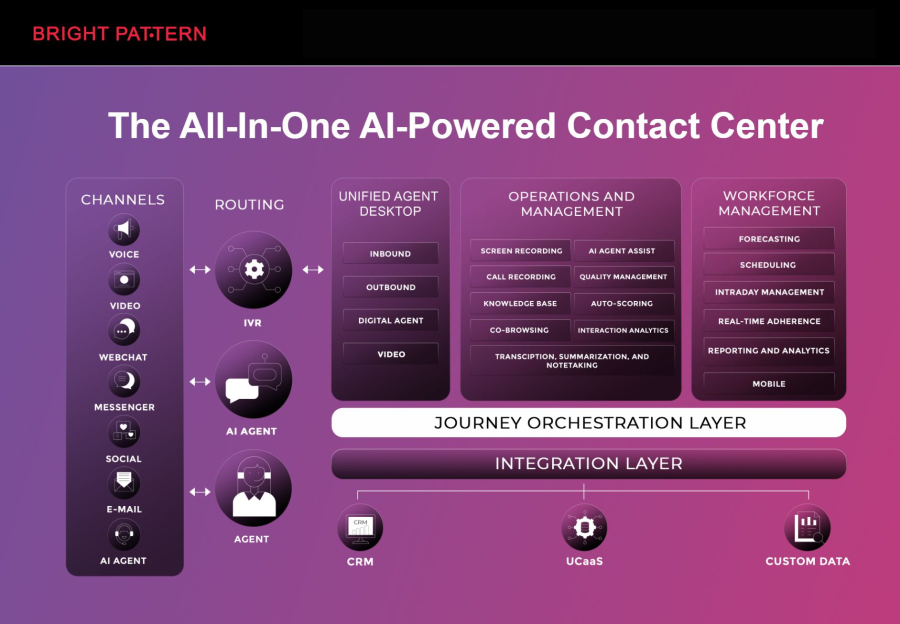
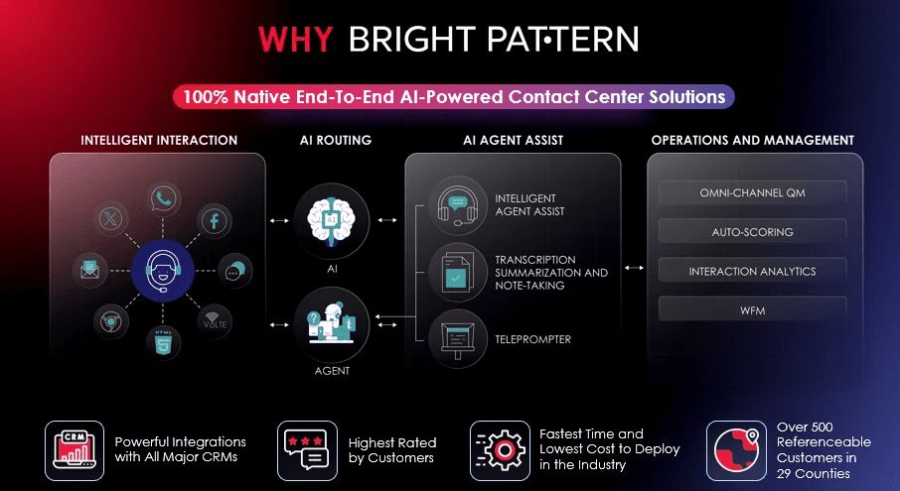
Bright Pattern is recognized as a leading provider of AI-powered contact center solutions, designed to streamline customer interactions across voice, chat, email, and social media. Their platform enables businesses to deliver seamless, personalized experiences while reducing wait times and boosting agent productivity.
Key features of Bright Pattern include:
- Omnichannel routing to connect customers with the right agent every time
- AI-powered virtual assistants that support agents and handle routine inquiries
- Real-time analytics and reporting for continuous process improvement
- Easy integration with CRM systems, messaging apps, and workflow tools
- Cloud-based infrastructure for scalability and flexibility
Bright Pattern’s solution is ideal for businesses seeking to implement an artificial intelligence call center agent that enhances customer satisfaction and operational efficiency while supporting rapid growth in their call center operations.
2. Five9 – Cloud Contact Center Software
Five9 offers a robust cloud-based platform with AI capabilities, including predictive dialing, intelligent routing, and virtual agents. It helps businesses optimize inbound and outbound call workflows.
3. Genesys Cloud CX – AI-Powered Customer Engagement
Genesys Cloud CX integrates AI into its contact center solutions to provide natural language understanding, predictive engagement, and automated workflows to improve customer experience.
4. Talkdesk – Next-Generation Call Center Solutions
Talkdesk uses AI to automate call handling, provide agent assistance, and deliver actionable insights. Its platform is designed to scale with businesses of all sizes.
5. NICE inContact – AI and Automation in Call Centers
NICE inContact combines AI and automation tools to improve agent performance, reduce operational costs, and enhance customer satisfaction through omnichannel support.
6. RingCentral Contact Center – AI Integration
RingCentral’s AI-driven platform provides smart call routing, sentiment analysis, and self-service capabilities, enabling businesses to enhance customer engagement efficiently.
7. 8x8 Contact Center – AI and Analytics
8x8 leverages AI to optimize call flows, assist agents in real time, and provide analytics for performance improvement. Its cloud contact center solution supports multiple communication channels.
8. Avaya OneCloud – Intelligent Customer Experience
Avaya OneCloud uses artificial intelligence call center agent technology to automate routine tasks, enhance agent productivity, and deliver consistent customer experiences across channels.
9. Cisco Contact Center – AI-Enhanced Solutions
Cisco provides AI-enabled call center tools that include predictive analytics, virtual agents, and omnichannel integration to streamline customer interactions.
10. Zendesk Talk – AI Support for Call Centers
Zendesk Talk incorporates AI to assist agents, provide contextual guidance, and optimize customer interactions, integrating seamlessly with CRM and support systems.
What Is an AI Call Assistant?
AnAI call assistantis a virtual agent that uses artificial intelligence to handle phone calls. It can understand what callers say or dial, respond with natural‑sounding speech, and take actions such as routing calls, answering questions, booking appointments, or capturing leads.
Instead of relying solely on human agents, businesses use AI call assistants to manage high volumes of calls more efficiently while still providing a human‑like experience.
Key Capabilities of an AI Call Assistant
- Speech recognitionthat converts spoken words into text in real time.
- Natural language understandingto interpret what the caller wants, even if they speak casually.
- Natural language generationto respond with clear, conversational language.
- Call routingthat sends callers to the right department or person based on their needs.
- Task automationsuch as scheduling, order lookups, and balance checks.
- Integrationwith CRM, ticketing, calendar, or billing systems.
- Analyticsthat reveal call volume, intent, sentiment, and outcomes.
How an AI Call Assistant Works (Step by Step)
While the underlying technology is complex, the call flow is straightforward from a business perspective.
- Caller dials your number.The call connects to your phone system, which passes it to the AI assistant.
- The assistant greets the caller.A natural, branded greeting sets the tone and invites the caller to explain what they need.
- The AI listens and understands.Speech recognition captures the caller’s words, and natural language models interpret their intent, such as"book an appointment"or"check my order".
- The assistant takes action.It may answer immediately, pull data from integrated systems, ask clarifying questions, or route the call to a person.
- Context is preserved.If the call is transferred, the human agent receives notes or a transcript so the caller does not have to repeat themselves.
- Insights are logged.The call outcome, sentiment, and key details are recorded for reporting and continuous improvement.
Core Benefits of Using an AI Call Assistant
AI call assistants are not just about saving time. They can reshape how your business connects with customers and prospects.
1. Never Miss a Revenue Opportunity
Missed calls often equal missed sales. An AI call assistant is available24/7/365, so every caller is greeted, guided, and captured, even after hours or during peak times.
- Capture leads when your team is busy or offline.
- Qualify callers and gather key information automatically.
- Offer callbacks, appointment slots, or self‑service options instead of voicemail.
2. Faster, Frictionless Customer Experiences
Long hold times and confusing menus frustrate customers. An AI assistant can dramatically shorten time to resolution.
- Understand natural speech instead of forcing callers through rigid menus.
- Provide instant answers to common questions.
- Direct callers to the right person on the first try, reducing transfers.
The result: highercustomer satisfactionand more positive brand perception, even on routine calls.
3. Higher Productivity for Your Team
When AI handles repetitive and predictable calls, your human agents can focus on high‑value interactions.
- Let AI manage FAQs, simple updates, and basic account information.
- Free agents for complex issues, upselling, and relationship building.
- Reduce burnout by offloading monotonous tasks.
This shift not only improves efficiency but also makes work more engaging for your team.
4. Consistent, On‑Brand Communication
Human agents can vary in how they greet callers, ask questions, or explain policies. An AI call assistant deliversconsistent messagingevery time.
- Standardize greetings, disclosures, and compliance statements.
- Ensure every caller hears the latest offers and policies.
- Apply your brand voice across every automated interaction.
5. Actionable Insights From Every Call
An AI call assistant can analyze large volumes of conversations and extract patterns that are difficult to see manually.
- Identify the most common questions and issues.
- Spot emerging trends in customer needs or complaints.
- Measure satisfaction, keywords, and outcomes to guide decisions.
These insights can feed back into product improvements, marketing messages, staffing, and training.
Popular Use Cases for AI Call Assistants
AI call assistants can support virtually any industry that relies on phone communication. Here are some of the most impactful use cases.
Customer Support and Service Desks
- Answer common troubleshooting questions.
- Provide order status, shipping updates, or account balances.
- Create and update support tickets automatically.
Sales and Lead Generation
- Qualify inbound leads by asking targeted questions.
- Route high‑value prospects directly to sales representatives.
- Capture contact details and preferences for follow‑up.
Appointment‑Driven Businesses
- Allow callers to book, change, or cancel appointments without waiting.
- Send confirmations or reminders via connected systems.
- Reduce no‑shows by simplifying rescheduling.
Operations and Internal Helpdesks
- Support employee IT or HR inquiries with automated responses.
- Route internal calls to the right teams based on intent.
- Standardize answers to policy and benefits questions.
Key Features to Look For in an AI Call Assistant
Not all AI call assistants are the same. When evaluating solutions, focus on capabilities that directly support your goals.
1. Natural, Human‑Like Conversations
The assistant should feel easy to talk to. Look for:
- High‑quality speech recognition for different accents and speaking styles.
- Natural tone and pacing in its spoken responses.
- Ability to handle interruptions, corrections, and clarifying questions.
2. Flexible Call Routing and Escalation
A powerful AI call assistant knows when to step back and hand the call to a human.
- Rules to escalate complex or sensitive issues.
- Warm transfer with a summary so callers are not repeating themselves.
- Department, skill‑based, or priority routing options.
3. Easy Integration With Existing Systems
To unlock full value, your AI assistant should connect with the tools you already use.
- CRM or customer database for personalized responses.
- Helpdesk or ticketing platforms for support workflows.
- Calendar, booking, or billing systems for self‑service tasks.
4. Analytics and Reporting
Comprehensive analytics turn raw call data into actionable insights.
- Dashboards for call volume, intent types, and resolutions.
- Transcripts or summaries for quality review.
- Performance metrics such as containment rate and satisfaction indicators.
5. Customization and Control
Your business is unique, and your AI call assistant should reflect that.
- Configurable greetings, flows, and decision trees.
- Options to define your brand voice and tone.
- Ability to update content quickly as your business evolves.
Sample AI Call Assistant Scenarios
The following examples illustrate how a well‑implemented AI assistant can streamline everyday calls.
| Scenario | Traditional Call Flow | AI Call Assistant Flow |
| Order Status | Caller waits in queue, reaches agent, provides details, agent checks system and responds. | Assistant asks for order number, checks integrated system, provides status instantly, offers tracking details. |
| Appointment Booking | Caller navigates long IVR menu, speaks to receptionist, compares times, books slot. | Caller simply says when they want to come in, assistant suggests times, confirms booking, and logs appointment. |
| Simple Tech Support | Agent walks caller through basic steps dozens of times per day. | Assistant guides caller through a structured troubleshooting script and resolves common issues automatically. |
Implementation Best Practices for Maximum Impact
Launching an AI call assistant is most successful when approached as a staged, strategic project rather than a quick switch.
1. Start With Clear Goals
Decide what success looks like before you design call flows.
- Do you want to reduce average wait times?
- Is your priority to increase after‑hours coverage?
- Are you focused on capturing more qualified leads?
These goals help you prioritize which call types to automate first.
2. Begin With High‑Volume, Low‑Complexity Calls
Quick wins build confidence and momentum.
- Identify the top 5 recurring caller questions or requests.
- Automate these with clear, straightforward flows.
- Gradually expand into more complex scenarios as you collect feedback.
3. Design for a Smooth Human Handoff
Automation works best when it is easy for callers to reach a person when needed.
- Offer an option to talk to a human at logical points in the conversation.
- Share context, notes, or transcripts with the agent on transfer.
- Train agents on how to pick up seamlessly from the AI.
4. Use Real Conversations to Improve the Assistant
Over time, your AI call assistant can become smarter and more effective.
- Review transcripts to find confusing moments or common phrases.
- Update intents, responses, and flows based on real‑world usage.
- Refine prompts, greetings, and follow‑up questions regularly.
5. Communicate Clearly With Customers
Callers are more comfortable with AI when they understand what it is and how it helps them.
- Introduce the assistant clearly at the start of the call.
- Explain what it can do and when a human will step in.
- Reassure callers that they can reach a person whenever they prefer.
Measuring Success: KPIs for Your AI Call Assistant
To prove value and continuously improve, track a set of meaningful performance indicators.
- Call containment rate– percentage of calls fully handled by the assistant without human intervention.
- Average handle time– time to resolve caller needs, with and without the assistant.
- First contact resolution– how often the caller’s issue is solved in one interaction.
- Customer satisfaction– survey scores, ratings, or qualitative feedback.
- Call abandonment– how many callers hang up before reaching help.
- Agent productivity– number of complex cases handled per agent and time spent on value‑added tasks.
Future Trends: Where AI Call Assistants Are Heading
AI call assistants are evolving quickly, bringing even more opportunities for businesses.
- More personalizationusing customer history and preferences to tailor every interaction.
- Omnichannel experienceswhere phone, chat, email, and messaging all share the same AI brain and context.
- Proactive outreachsuch as automated reminder calls, satisfaction checks, or follow‑up on key events.
- Richer analyticsthat predict needs and recommend next best actions for agents and managers.
Frequently Asked Questions About AI Call Assistants
Will an AI call assistant replace human agents?
An AI call assistant is best used as apartnerto your team, not a replacement. It takes care of repetitive tasks and high‑volume calls so humans can focus on complex, emotional, and high‑value conversations where human judgment and empathy are essential.
Is it difficult to train and maintain an AI call assistant?
Modern solutions are designed for business users rather than only technical specialists. Initial setup requires planning and testing, but once deployed, you can typically adjust flows, prompts, and responses through user‑friendly interfaces. Regular review of call data helps keep the assistant accurate and effective.
How do callers react to talking with AI?
When implemented well, many callers appreciate thespeed and convenienceof AI. Clear introductions, natural conversation, and easy access to a human when needed lead to positive experiences. Over time, customers tend to value the ability to get fast answers at any time of day.
Is an AI call assistant suitable for small businesses?
Yes. Smaller teams often feel the impact of missed calls or limited hours more acutely. An AI call assistant can extend coverage, protect every lead, and make a small team feel much larger and more responsive without adding full‑time headcount.
Conclusion: Turning Your Phone Line Into a Growth Engine
An AI call assistant is more than a voice bot. It is a powerful, always‑on ally that helps you answer every call, serve customers faster, and uncover insights hidden in everyday conversations.
By starting with clear goals, automating the right call types, and keeping humans at the heart of your customer experience, you can transform your phone channel from a cost center into a reliable growth engine.
The businesses that embrace AI call assistants today are setting a new standard for responsiveness, personalization, and efficiency. With the right strategy, your next call can be the beginning of a better, smarter, and more profitable way of working.
